1. Start with Ahankaar

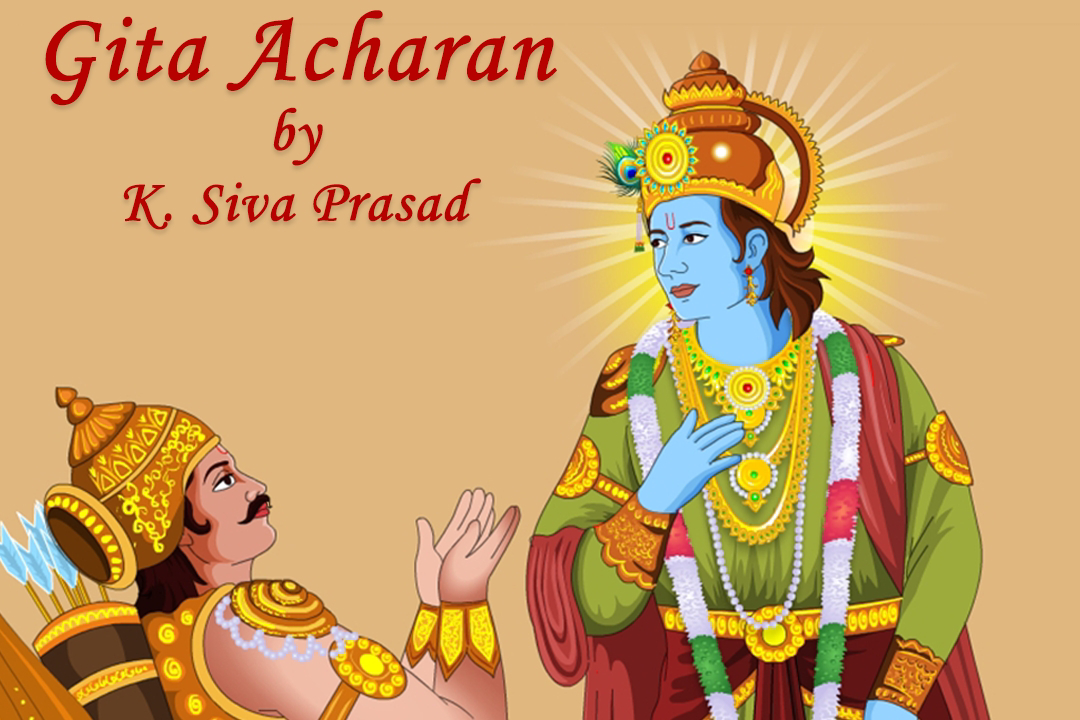
The Bhagavad Gita is a seven hundred verse
conversation between Lord Krishna and the warrior Arjuna on the battlefield of
Kurukshetra.
In the final
moments before the war, Arjuna felt that the war would kill many of his friends,
teachers and relatives. He concluded that this has many harmful and undesirable
effects.
Arjuna is
perceiving both himself and others on the battlefield as karta (doers).
This perception is nothing but ahankaar, a combination of aham
(I) and karta (doer), literally meaning ‘I am the doer’. Though we are
all part of the same oneness, ahankaar keeps giving us the impression
that we are distinct and separate. Usually, ego is taken as the meaning of ahankaar,
but ego can be taken as one of the many manifestations of ahankaar.
The entire conversation revolves around ahankaar, whether addressed
directly or indirectly, and Krishna offers multiple paths, milestones, and
yardsticks to help us transcend it. If we view the Kurukshetra war as a
metaphor, each of us repeatedly finds ourselves in similar situations in our
daily lives -within the family, the workplace, and in matters of health,
wealth, and relationships. As long as we live, such dilemmas continue to arise,
until ahankaar is truly understood.
The Gita is
all about our being, not about our knowing or doing. No amount of theory alone
can teach us to ride a bicycle or swim. Similarly, no amount of philosophy can
help us unless we experience life with awareness. The guiding principles of the Gita
help us reach the eternal state of our inner self, free from ahankaar.
From the
surface, it appears that times have changed since the Gita was given to Arjuna
by Lord Krishna. Certainly, there is a lot of change brought about by
developments in science in the past couple of centuries. But in reality, from
an evolutionary standpoint, humans didn’t evolve any further. The internal side
of the dilemma remains the same. In essence, the external appearances might
look different, but the inner foundation is the same oneness.


So true !!!
ReplyDeleteVery insightful and compells all of us to search for the real meaning and purpose ! waiting to read more !!!