14. Being Witness

If one word could describe the entire Gita it would be ‘drishta’
(witness), which appears in many contexts. An understanding of this is
important as we think that ‘we’ do things and control situations. We need to
free ourselves from this notion to lead a life of joy.
Arjuna, who was about sixty years old at the time of the Kurukshetra war,
had lived a good life and enjoyed all luxuries. As a warrior he had tasted
victory in many battles. At the time of war, he felt that he was the karta (aham-karta;
ahankaar) and felt that he would be responsible for the death of his kith
and kin. This led to his despondency on the battlefield.
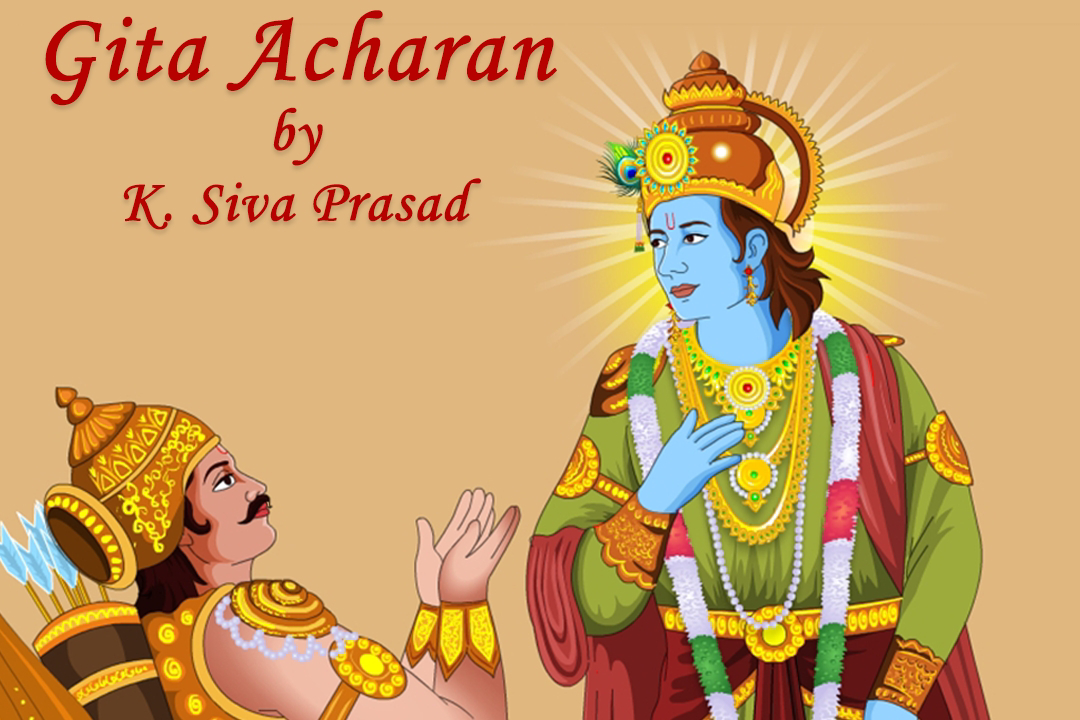
The entire Gita is Lord Krishna’s attempt to tell him that he is not the karta.
The Lord reveals that Arjuna is ‘drishta/sakshi’ - a witness. When we
start realising ourselves to be nimitta-maatra – an instrument in
the hands of the Almighty, we are on the firm path towards ‘being a witness’. In
this state, Paramatma is recognised as the doer of all actions, while we
see ourselves only as instruments through which they are performed.
Most of us believe that we are the cause of all our actions and masters of
our destiny. In the Gita, Lord Krishna says that interaction between gunas
creates karma, but not due to any karta (3.27). When we realise
this fact at the existential level, we will enter the state of a sakshi.
Drishta (sakshi) is a state of intellect but is not
manifest in the physical world. It is the ability that helps us to step back
from the day-to-day happenings around us and have internal stability. It helps
us realise that we should always act without desiring any particular outcome (karma-phal)
(2.47). It is the ability to witness our feelings and subordinate them.
Krishna explains various aspects of sakshi and says that he truly
sees who perceives Parameshwar (supreme Lord) present equally in all
beings as the imperishable among the perishable (13.28); He who sees all
actions are performed by prakriti (nature) alone and the Self as
non-executor, he sees (13.30).


Comments
Post a Comment