Posts

182. Dedicating Karmas to Paramatma.

Image
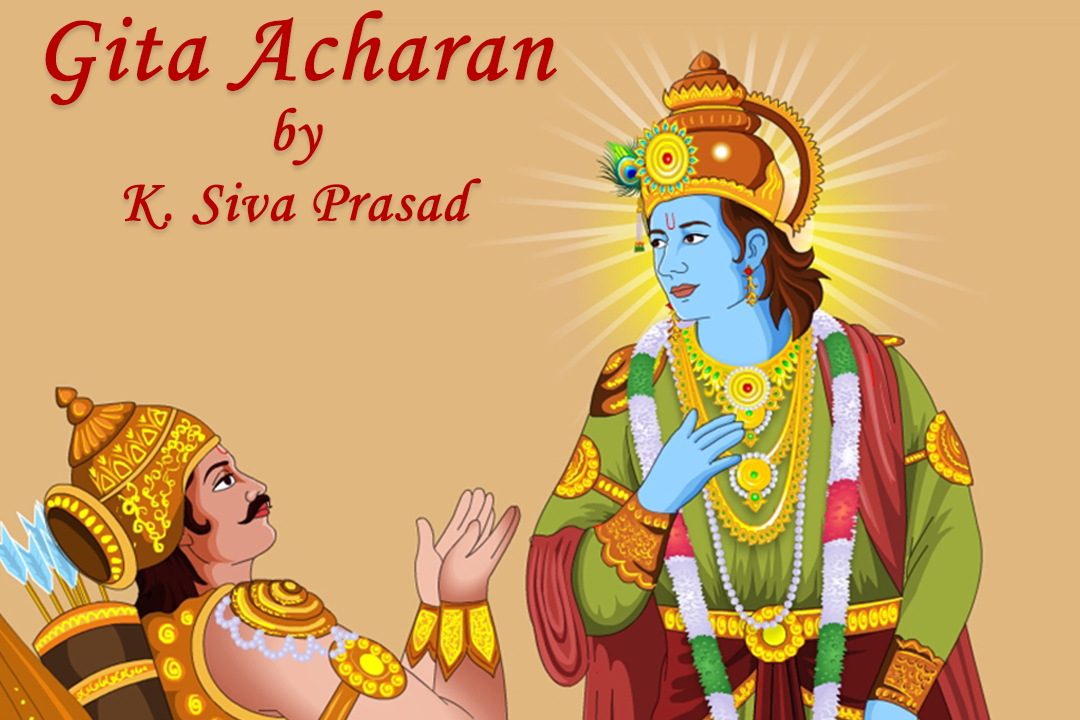
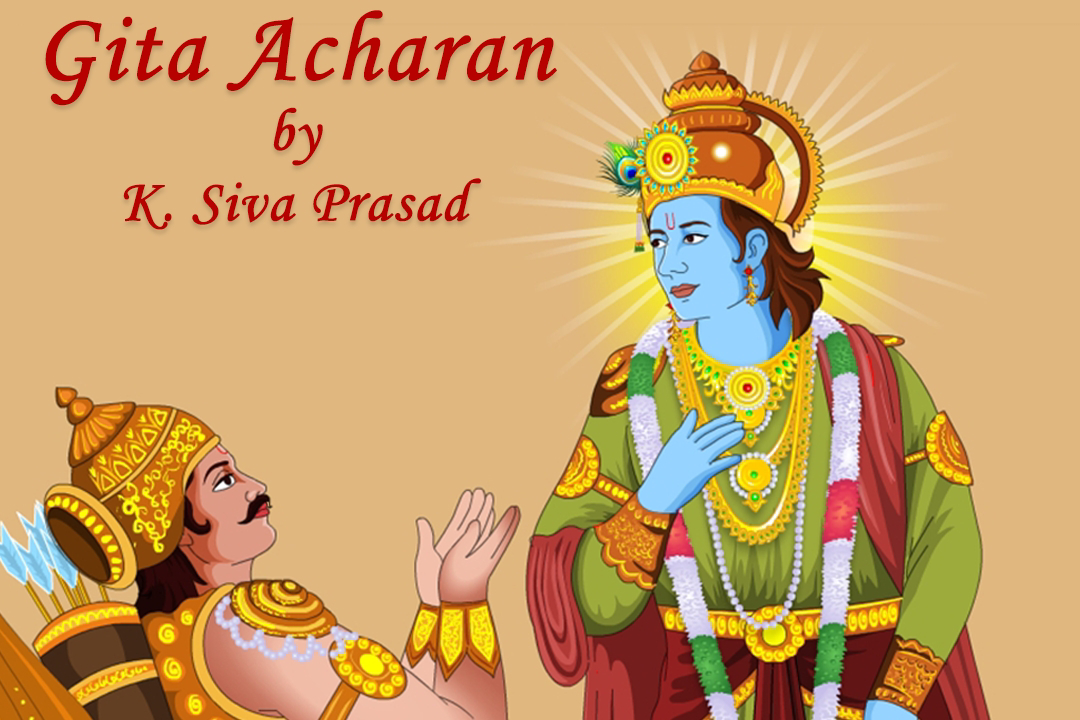
T he cerebrum of the brain is divided into two halves - the right and left hemispheres. Though they work in tandem, the right side of the brain dominates the functions related to creativity, emotions etc. whereas the left side of the brain dominates analytical and logical functions. When viewed in the context of the Gita, right brain persons get attracted to devotion ( bhakti ) while left brain persons towards awareness ( sankhya ). Karma (action) is common for both. For sankhya oriented people, Krishna earlier gave the logic that none can remain without doing karma even for a moment as we are bound to perform karmas because of gunas (3.5, 3.27). This is pure awareness that gunas are the real karta . For the bhakti oriented, Krishna says, “But those who dedicate all their karmas to Me, regarding Me as the Supreme goal, worshipping Me and meditating on Me with exclusive devotion, O Parth, I swiftly free them from the ocean of birth and death ( sansar ), for their ...
181. The Starting Point

Image
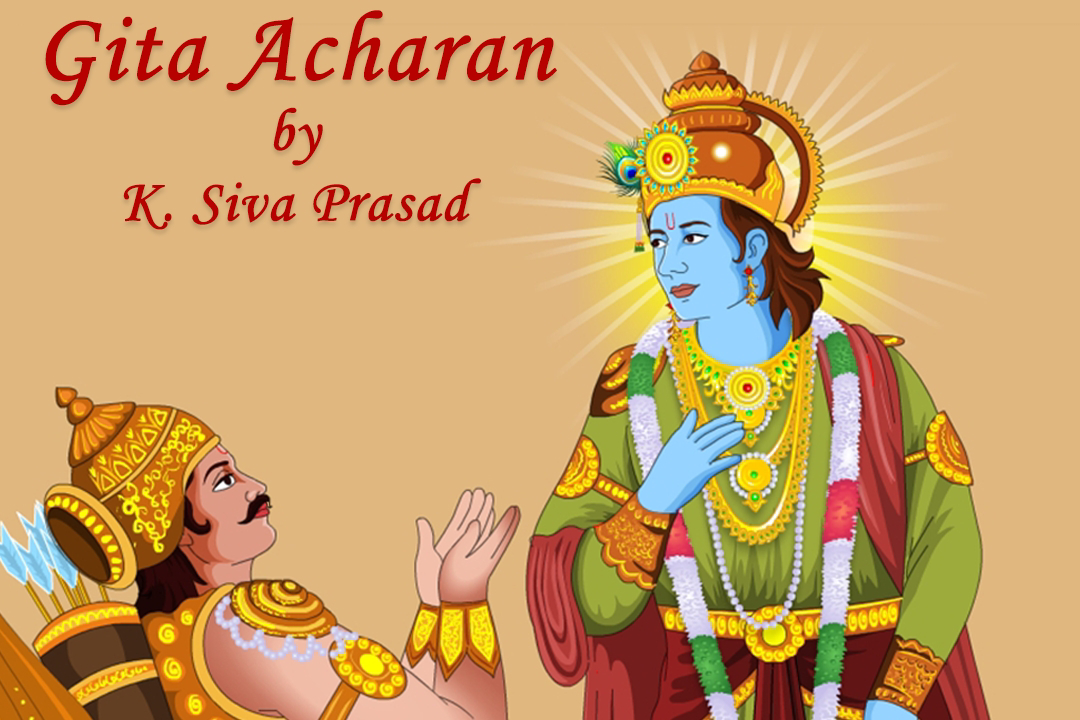
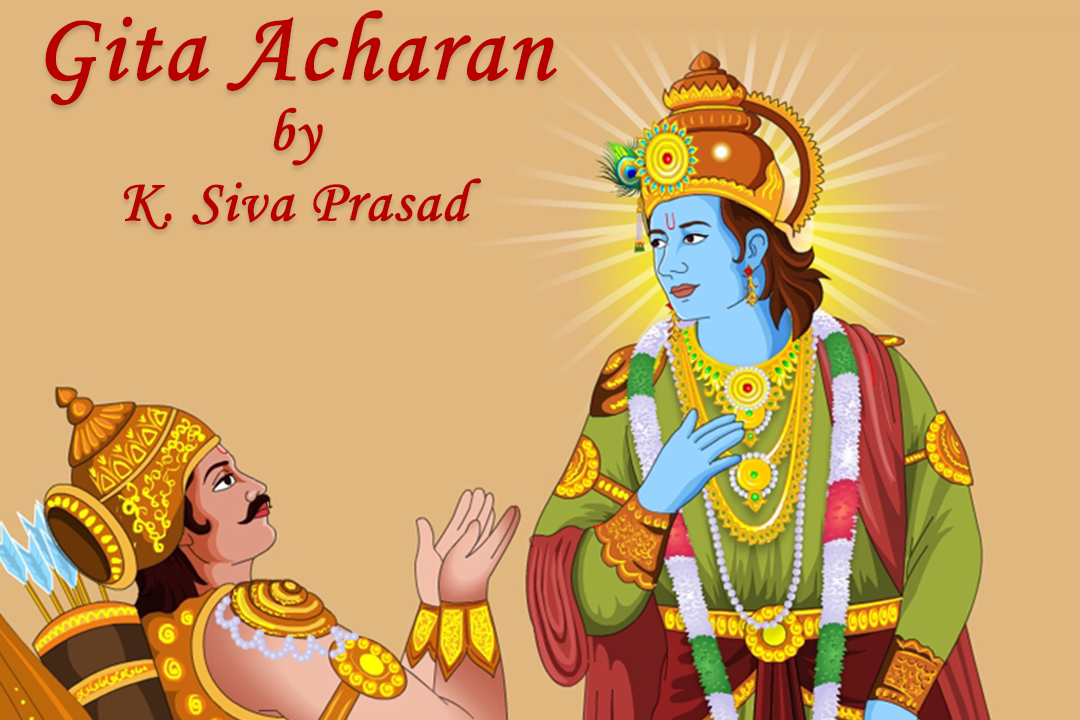
K rishna says, “Those who fix their minds on Me, worship Me (in the manifested Form) endowed with shraddha (trust), I consider them to be the best in yoga ” (12.2). Though this answer is specific to Arjuna, it broadly applies to all of us. Secondly, shraddha is the foundation for any spiritual journey. Krishna immediately clarifies that the path of the Formless or Unmanifest is also a path to reach him. He says, “But those who worship the Formless aspect of the Imperishable, the Indescribable, the Unmanifest, the All-pervading, the Incomprehensible, the Unchanging, the Eternal, and the Immutable; by restraining their senses and possess even mindedness in every circumstance, such persons, rejoicing in the welfare of all beings, also attain Me” (12.3-12.4).   He compares both paths and says, “For those whose minds are attached to the Unmanifest, the path of realization is full of difficulties. Worship of the Unmanifest is exceedingly difficult for embodied beings” (...

180. Form or Formless

Image
A t the end of the eleventh chapter (11.55), Krishna says that He can only be attained through bhakti (devotion). Thus, the revered twelfth chapter of the Bhagavad Gita is called ‘Bhakti Yoga’ . Arjuna was terrified and frightened to see the original Form ( saakaar ) of Krishna ( Vishwaroop ) and enquires, “Between those who are steadfastly devoted to You (Form) and those who worship the imperishable and unmanifest (Formless - niraakaar, nirgun ), whom do you consider to be more perfect in yoga ” (12.1)? Incidentally, all cultures have roots in this question. In the Gita, three broad paths are given. karma (action) for mind-oriented people; sankhya (awareness) for buddhi (intellect) oriented and bhakti (devotion) for heart oriented. Certainly, they are not watertight paths, and a lot of crisscrossing takes place between them and that’s what is reflected in this chapter. Krishna earlier gave a hierarchy and said that the mind is superior to the senses; buddhi is super...

179. Shifting Goalposts

Image
A doctor, working at a mental hospital, took a friend to show him the hospital. His friend saw a man in a room with a photo of a woman. The doctor explained that the man loved that woman and got mentally unstable when he couldn’t marry her. In the next room, there was another man with the same woman’s photo and the doctor explained that he got mentally unstable after marrying her. This ironic story explains how fulfilled as well as unfulfilled desires can have similar disastrous consequences. The same thing happened with Arjuna. At the beginning of the eleventh chapter of the Bhagavad Gita titled ‘ Vishwaroop Darshana Yoga ’, he wanted to see Krishna in His opulent form. But he was frightened when he saw the Vishwaroop of Krishna. Shaken, Arjuna now desires to see Krishna in his original form. Similarly, our goalposts in life keep shifting with time. Krishna shows his Vishwaroop in which Arjuna sees that all his enemies are entering into the mouth of death. Krishna te...

178. Hatred is Misery

Image
K rishna says, “This form of mine has not been seen before by anyone else than you (11.47). Neither by study of the Vedas , nor by yajnas , nor by gifts, nor by rituals, nor by severe austerities can I be seen in such a form (11.48). Be free from fear and with a cheerful heart, behold Me once again in My personal form” (11.49). Krishna comes to his original form (11.50) and Arjuna resorts to his nature (11.51). Krishna says, “Very hard to see this form of mine and even gods ever long to behold this form (11.52). Neither by the study of the Vedas , nor by penance, charity, or fire sacrifices can I be seen like this” (11.53). Our general belief is that charity gives us punya (virtue). But Krishna says charity can’t help us see his Vishwaroop . When our charity is driven by ahankaar , it then becomes a transaction of giving something of ours to get something like punya (virtue). This barter can’t take us to Paramatma as He can’t be bought. Immediately, Krishna offers a...

177. Grace in Relationships

Image
T rembling, saluting with joined palms, bowing, overwhelmed with fear (11.35), Arjuna says, “The world is delighted and rejoices in your praise; rakshasas (demons) flee in terror and siddhas (perfected ones) bow (11.36) as you are the primal cause even to Brahma , Lord of Gods, Abode of the universe. You are the imperishable, the being and non-being, that which is supreme (11.37). You are the knower, the object of knowledge, and the Supreme Goal. By You is the universe pervaded, Being of infinite forms” (11.38). Arjuna further says that He is Vayu (wind), Yama (God of death), Agni (fire), and Varuna (sea god) (11.39); and offers salutations (11.40). He continues, “You are the father of this world, of the moving and unmoving, greater than the greatest, none equal to you” (11.43). Arjuna bows, prostrates and seeks His grace as a son from father; a lover from a beloved; a friend with a friend (11.44). Arjuna is delighted to see what had never been seen before, and at the...

176. From Friend to Paramatma

Image
D ifferent belief systems describe Paramatma with different names and in different ways. Depending on our belief system, the appearance of Paramatma differs and if He appears before us in a different form, it would be impossible to recognize Him. Similarly, Arjuna was treating Krishna like a friend for decades. He couldn’t recognise that Krishna is Paramatma till he saw His Vishwaroop . He profoundly apologises and says that “Thinking of You as my friend, I presumptuously addressed You as, ‘O Krishna’, ‘O Yadav’, ‘O my dear Friend’. I was ignorant of Your Majesty, showing negligence and undue affection. And if, jestfully, I treated you with disrespect or insulted you, while playing, resting, sitting, eating, when alone, or before others - for all that I crave forgiveness” (11.41-11.42). Like Arjuna, the same would happen to any of us when we reach that eternal state of surrender. We would realise that everyone around us is a part of Paramatma . In other words, every ...